SAS
2026
SAS AML Suspicious Activity Report Design
A streamlined Suspicious Activity Report Experience for SAS Anti-Money Laundering, simplifying complex workflows and improving the reporting process for investigators

Overview
This case study focuses on my design work at SAS, a global analytics and software company that helps organizations make better decisions through data, artificial intelligence, and advanced analytics.
During my internship, I worked on several projects spanning user research, workflow analysis, and product design. This case study focuses on my improvements to the Suspicious Activity Report experience within SAS Anti-Money Laundering. Through research and design exploration, I identified opportunities to streamline workflows, reduce complexity, and support more efficient regulatory reporting.
Problem
Summary
The Suspicious Activity Report (SAR) process within SAS Anti-Money Laundering was fragmented. The challenge was to simplify the information architecture and reporting workflow to reduce friction, improve usability, and help investigators create accurate regulatory reports more efficiently.
My Role
As the UX designer, I conducted user research with AML subject matter experts and stakeholders, analyzed existing workflows and pain points, and translated those insights into redesigned user flows, information architecture, and interface concepts to improve the Suspicious Activity Report (SAR) experience.
Existing Issues
The existing SAR experience was fragmented and heavily reliant on manual processes. Users were required to navigate across multiple disconnected pages, repeatedly enter information that already existed elsewhere in the system, and switch between different sections to complete a single report.
Data-Driven Insights
Client feedback consistently highlighted frustrations with the SAR reporting process, particularly around excessive navigation, fragmented workflows, and repetitive data entry. Users noted that critical information was spread across multiple pages, making it difficult to maintain context and efficiently complete reports. They also expressed challenges with creating SAR narratives and cited the overall reporting experience as unnecessarily complex and time-consuming.

Goals
Summary
• Simplify the SAR reporting experience by reducing navigation complexity and unnecessary clicks.
• Create a more intuitive, task-driven workflow that aligns with how investigators naturally build and submit reports.
• Reduce manual and repetitive data entry by improving information organization and workflow efficiency.
• Improve the quality and consistency of SAR submissions through clearer structure and better user guidance.
Guiding Questions
• How might I reduce the number of steps and screens required to complete a SAR?
• How might I organize information in a way that matches investigators' mental models and workflows?
• How might I make the SAR process more intuitive while maintaining regulatory requirements?
• How might I transform a fragmented reporting experience into a unified, seamless workflow?
Research
Competitive Analysis
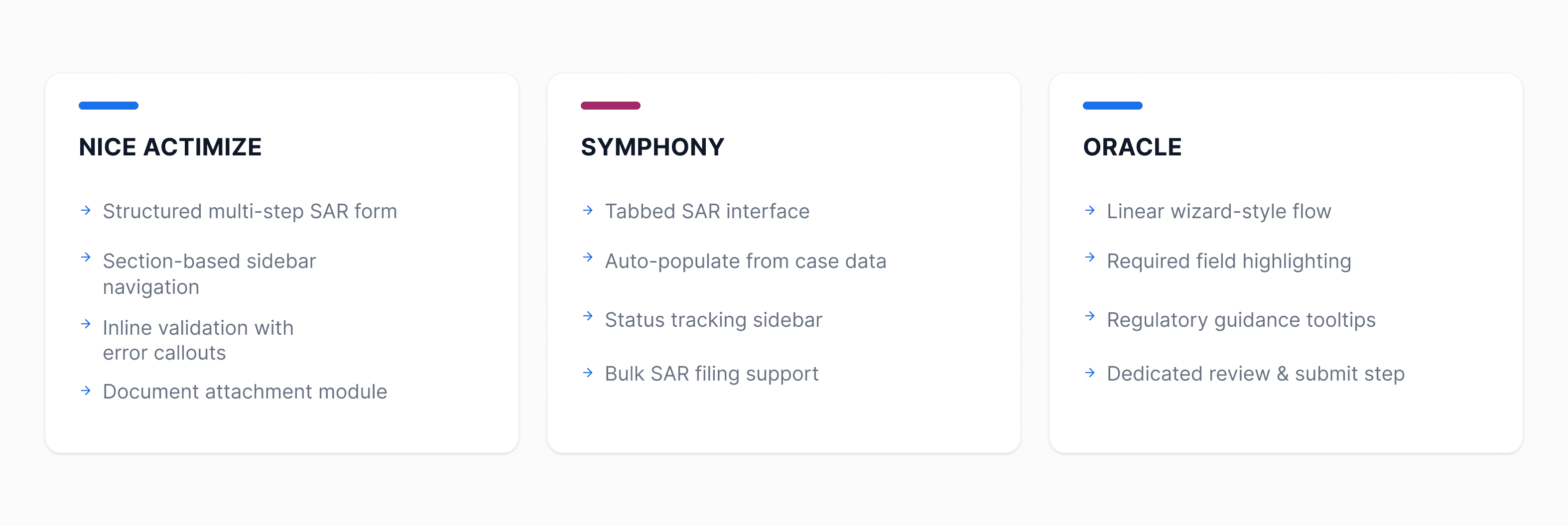
I conducted a competitive analysis of leading AML solutions to understand how SAR reporting is structured across the industry. By examining workflows, navigation models, and reporting features, I identified patterns and opportunities that informed the redesign of the SAR experience.
User Interviews
I conducted user interviews with AML experts and business stakeholders who work closely with investigators and regulatory reporting workflows. During each session, I asked open-ended questions about current processes, pain points, user needs, and industry practices, while also exploring how different organizations structure their AML programs.

Card Sorting Exercise
To redesign the SAR information architecture, I conducted a card sorting exercise using the existing SAR fields and sections. Each field was written on an individual card and grouped into categories based on logical relationships and user mental models. This helped simplify the information architecture, reduce navigation complexity, and create a workflow that better aligns with how investigators think and work.

Design Process
Information Architecture

Lessons
Final Thoughts


